

Why Two Identical Bearings Have Different Lives (2026)
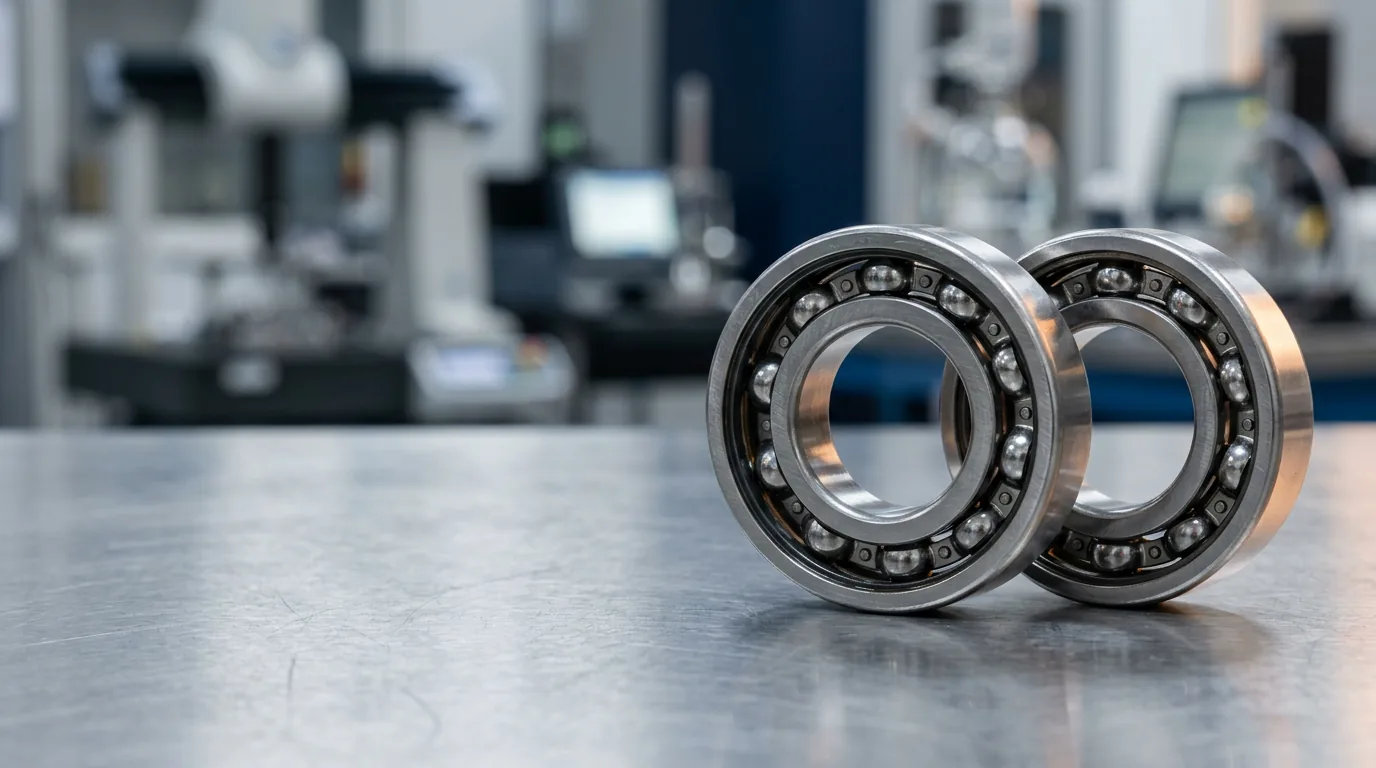
Same number. Same size. One outlasts the other by ten times. Two bearings with the exact same part number, like a 6204, can have drastically different lifespans because internal components like ball grade and ring precision vary between manufacturers. Buyers of industrial bearings Pakistan often assume all bearings of the same number are essentially the same. This dangerous perception leads to unexpected failures and massive downtime.
The difference between a bearing that lasts a year and one that fails in a month lies hidden inside the steel. This guide reveals why cheap bearings fail, exploring how internal ball grade and raceway precision define a bearing's true lifespan. By understanding what happens beneath the surface, procurement managers can stop buying replacements and start investing in reliability.
Why do two identical-looking bearings have completely different lifespans?
Two bearings with the exact same part number, like a 6204, can have drastically different lifespans because internal components like ball grade and ring precision vary between manufacturers. Relying solely on the external part number is the leading cause of unexpected bearing failure in industrial machinery.
The bearing number meaning - such as 6204 or 6201 - only dictates the external dimensions of bore, outer diameter, and width. It does not guarantee the internal quality, the manufacturing tolerances, or the grade of the steel balls inside. Many procurement managers assume that matching the part number is enough. This is exactly why cheap bearings fail. A bearing that looks perfect to the naked eye might harbor microscopic geometric errors that act as stress raisers, initiating cracks under heavy loads[1][2].
Inside the bearing, microscopic imperfections dictate lifespan. Only 3-5% of bearing failures are due to normal rolling-contact fatigue; 95-97% are caused by preventable issues like contamination, poor lubrication, or inadequate internal design[3]. When manufacturers cut costs, they use lower-grade balls and less precise rings. These slight variations force the bearing to distribute loads unevenly. As a result, certain balls carry a disproportionately higher share of radial and axial load, increasing their cyclic stress and fatigue damage[1][4][2].
In high-speed and high-load environments, these hidden internal flaws generate excess friction and heat. The rougher surfaces generate higher micro-contact pressures at asperities, accelerating subsurface shear stress cycling[1][4]. This classic rolling contact fatigue mechanism initiates pitting and spalling much earlier than expected[1][4][2]. For those sourcing Deep Groove Ball Bearings or other mechanical components, understanding that the part number is merely a sizing guideline is the first step toward preventing catastrophic machinery breakdowns.
What is the difference between G10 and G16 bearing balls?
Lower-quality bearings often use inconsistent G16 grade balls, which create uneven rotation and micro-stresses that can reduce a bearing's lifespan from a year to just one month. To achieve maximum service life, high-precision G10 balls must be perfectly matched with high-precision rings - a standard manufacturing practice for HI-TEC bearings in Pakistan.
The "G" stands for grade, a standardized measure of ball precision defining geometric tolerances and surface finish[1][4][5]. A lower grade number indicates higher precision[1][4][6]. While both are considered precision grades, G10 balls typically cut geometric errors by about 30-40% compared to G16, reducing the diameter spread in a lot by about the same proportion[4][7][5].
When evaluating cheap vs quality bearings, the internal components tell the real story. A G16 ball has a sphericity deviation of up to 0.40 μm, whereas a G10 ball tightens this to 0.25 μm max[4][7][5]. This microscopic difference in roundness means the G16 ball contacts the raceway over a slightly distorted area, increasing peak local contact stress[4][5].
| Parameter (typical steel ball) | G10 Grade | G16 Grade |
|---|---|---|
| Sphericity (deviation from perfect sphere) | 0.25 μm max[4][7][5] | 0.40 μm max[4][7][5] |
| Lot diameter variation (batch) | 0.50 μm max[4][7][5] | 0.80 μm max[4][7][5] |
| Surface roughness Ra | 0.020–0.025 μm[4][7][5] | 0.025 μm[4][7][5] |
A G10 ball only delivers its full advantage when paired with equally high-precision rings. If premium balls run on poorly machined raceways, the investment is wasted. HI-TEC bearing quality relies on this exact pairing. Tighter tolerances and smoother surfaces reduce rolling friction, improving mechanical efficiency and lowering operating temperatures[8][9][10][2]. The slightly smoother G10 surface reduces asperity loading and friction, directly lowering micro-stress amplitude per cycle[1][4][9][2].
How can you extend bearing life and avoid premature industrial failures?
The real cost of a bearing failure is not the price of the part, but the expensive downtime and labor required to replace it. Specifying G10 ball grade and verified ring precision standards during procurement is the most effective way to extend bearing life.
Initial bearing purchase price is usually less than 10-15% of its total cost of ownership; 85-90% or more comes from operating, maintenance, and downtime costs[11]. When industrial buyers focus solely on upfront price, they ignore the devastating financial impact of machinery stopping unexpectedly. Unplanned manufacturing downtime averages about $260,000 per hour across industries[12][13][14]. Even in smaller facilities, a $200 bearing replaced proactively can avoid a $15,000+ emergency event, a 75x cost difference that is reported as typical across industries[15].
To avoid these catastrophic causes of bearing failure, implement these specific procurement and maintenance steps:
- Look beyond the part number: Never assume two bearings are identical just because they share a designation like 6204. Verify the internal specifications.
- Specify G10 ball grades: Ensure your supplier uses G10 balls matched with high-precision rings to reduce micro-stresses and extend fatigue life in high-speed, high-load, and low-noise applications[1][4][5].
- Calculate the true cost of downtime: Factor in lost production, idle labor, and emergency parts premiums, which typically cost 30-40% more than planned purchases[12][13].
- Partner with verified experts: Work with suppliers who understand internal tolerances and load capacities. For tailored recommendations, contact us via WhatsApp for bearing selection support.
- Prioritize predictive maintenance: Predictive bearing programs and precision maintenance commonly reduce unplanned stoppages by 20-50% and cut total costs by 10-40%[15][11].
By upgrading to higher-quality internal components, facilities dramatically reduce the frequency of reactive, failure-driven repairs.
Frequently Asked Questions
Why do bearings fail prematurely?
Only 3-5% of bearing failures are due to normal fatigue; 95-97% result from preventable issues like contamination, poor lubrication, or inadequate internal design[3]. Low-quality internal components, such as inconsistent G16 balls, create uneven rotation and micro-stresses that accelerate wear and tear, leading to early failure.
Are cheap bearings worth it?
No. The initial purchase price of a bearing is typically less than 10-15% of its total cost of ownership[11]. Cheap bearings often use lower-grade materials and looser tolerances, resulting in rapid failure that triggers expensive secondary equipment damage and massive production losses.
What is the real cost of a bearing failure?
The real cost is driven by unplanned downtime, maintenance labor, and emergency parts, which account for 85-90% or more of the total lifecycle cost[11]. A single reactive replacement event can cost 75 times more than proactively replacing the bearing during scheduled maintenance[15].
How can I extend bearing life?
You can significantly extend bearing life by specifying high-precision G10 balls matched with high-precision rings, ensuring proper lubrication, and implementing predictive maintenance programs. These steps reduce rolling friction, lower operating temperatures, and minimize the micro-stresses that cause premature metal fatigue.
References
- Ball (bearing) - Wikipedia. https://en.wikipedia.org/wiki/Ball_(bearing) (2009-06-30)
- Understanding Grade and Tolerance for Industrial Balls. https://strindustries.com/understanding-of-grade-and-tolerance/ (2023-10-11)
- Wind energy LCOE: Bearing purchase price vs. total cost of ownership. https://www.windsystemsmag.com/wind-energy-lcoe-bearing-purchase-price-vs-total-cost-of-ownership/ (2024-11-18)
- Precision Ball Grade Tolerance Chart | ABMA & ISO Standards. https://hartfordtechnologies.com/ball-size-grade-tolerance-definitions/ (2026-05-08)
- Precision grades - redhill-balls.. https://www.redhillballs.com/company/precision-grades/ (2025-01-30)
- What Do Precision Ball Grades G10, G20, and G100 Mean?. https://www.czhuari.com/new_detail/nid/105839.html (2025-05-28)
- [PDF] Manufacturing standard - Metalball. https://www.metal-ball.com/wp-content/uploads/2016/02/manufacturing-std.pdf (2026-06-19)
- Enhancing Equipment Functionality with G10 and G16 Precision .... https://www.hczbbearing.com/news-details/2063493698396676096.html (2026-06-07)
- Steel Ball Grades Explained: G10, G100, G1000 and What They Mean. https://sdballs.com/blog/steel-ball/ (2026-04-22)
- Different Ceramic Bearing Ball Grades and How to Choose. https://www.preciseceramic.com/blog/different-ceramic-bearing-ball-grades-and-how-to-choose.html (2024-09-14)
- Total Cost of Ownership in Maintenance and Reliability Contexts. https://reliabilityx.com/total-cost-of-ownership-in-maintenance-and-reliability-contexts/ (2026-01-18)
- The Real Cost of Unplanned Downtime in Manufacturing (2026 Data). https://reliamag.com/articles/cost-unplanned-downtime-manufacturing/ (2026-04-24)
- The Hidden Cost of Unplanned Downtime in Manufacturing. https://ifactoryapp.com/blog/hidden-cost-unplanned-downtime-manufacturing (2025-12-18)
- Cost of Downtime in Manufacturing: Data, Formulas & Fixes (2026). https://www.arda.cards/post/the-alarming-costs-of-downtime-how-lost-production-time-threatens-your-bottom-line-in-2025 (2026-03-24)
- Bearing Failure Prediction: Sensors, Stages & CMMS Integration .... https://oxmaint.com/blog/post/blog-post-bearing-failure-prediction-sensors-cmms (2026-04-29)