

Why Bearings Fail Faster in Electric Motors (2026 Guide)
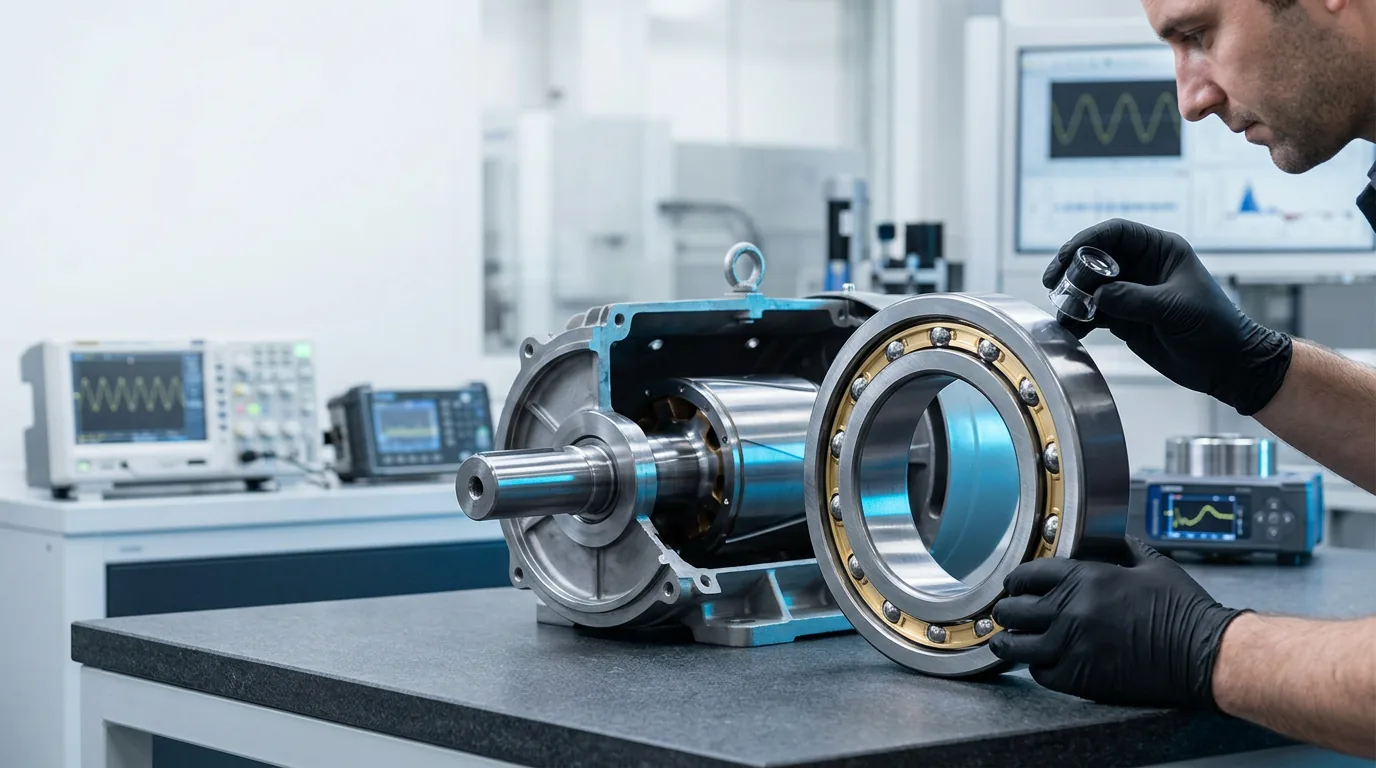
Of every machine on your floor, the one in electric motors kills bearings fastest. Bearings fail faster in electric motors because high-speed continuous duty and electrical erosion expose low-quality steel and poor vibration grades faster than other industrial applications. Treating electric motor bearing failure as an unavoidable cost is a mistake - investing in correct Z3V3-rated sourcing is the cheapest insurance against unplanned downtime.
For facilities operating continuous production lines, a failing motor means halted operations and lost revenue. Sourcing the correct bearing for electric motor Pakistan is not just about matching dimensions; it requires understanding the specific thermal, mechanical, and electrical stresses that destroy standard commercial bearings.
This guide breaks down the exact mechanisms that cause premature failure in electric motors. We will explore how modern drives induce electrical erosion, why standard precision grades fall short at high speeds, and how specifying the correct noise and vibration ratings can permanently eliminate these recurring breakdowns on your factory floor.
Why do bearings fail prematurely in electric motors?
Bearings fail faster in electric motors because high-speed continuous duty, rapid heat buildup, and electrical erosion expose low-quality steel and poor vibration grades faster than other industrial applications. Treating electric motor bearing failure as an unavoidable cost is a mistake - the stress profile of electric motors simply exposes sourcing shortcuts faster than anywhere else.
When analyzing the causes of bearing failure, the most destructive force in modern electric motors is electrical erosion, often called fluting. When motors are driven by Variable Frequency Drives (VFDs), parasitic coupling induces a common-mode voltage on the motor shaft[1][2]. Once this voltage exceeds the dielectric strength of the bearing grease, it arcs through the bearing to ground, acting like electric discharge machining (EDM)[3]. This arcing creates micro-craters and evenly spaced washboard grooves on the raceways[4]. While standard bearings should last five or more years in continuous duty, electrical discharge can destroy them within a few months[3].
Beyond electrical damage, continuous high-speed operation fundamentally changes the lubrication regime. Rapid acceleration increases contact pressure and shear within the lubricant, raising temperatures and accelerating grease oxidation[5]. As bearings wear, friction increases, causing the motor to draw more current and generate even more heat[6][7]. This self-reinforcing cycle of heat and friction rapidly degrades the steel's fatigue strength[8].
When facilities rely on cheap, unverified components to handle these forces, failure is inevitable. The true cost of cheap bearings in Pakistan becomes apparent when high speeds and electrical stresses shatter brittle steel and degrade poor lubricants. Electric motors do not tolerate standard commercial weaknesses; they require components engineered specifically for high-speed, high-stress environments to prevent catastrophic, unplanned downtime.
What bearing grade is best for an electric motor?
High-speed electric motors require bearings with a Z3V3 noise and vibration grade and at least P6 precision to ensure smooth, quiet, and long-life running under continuous stress. While standard commercial precision is acceptable for low-speed machinery, electric motors demand tighter tolerances and superior vibration control to survive.
Bearing grades are defined by two distinct metrics: precision class (dimensional tolerance) and noise/vibration grade. Precision classes like P0 (Normal) and P6 dictate the physical geometry of the bearing[9][10]. Noise and vibration grades like Z3V3 measure the actual acoustic output and structure-borne vibration velocity during operation[11][12]. A Z3V3 rating indicates a premium, super-silent bearing with extremely low vibration velocity across all frequency bands[11][12].
| Specification | HI-TEC Standard Line | HI-TEC SILVER Line | Best Application |
|---|---|---|---|
| Precision Grade | P0 (Normal / ABEC 1) | P6 (ABEC 3) | P6 reduces radial runout for high-speed stability[13][14]. |
| Vibration Grade | V1 (Standard) | V3 (Super Silent) | V3 minimizes internal friction, metal fatigue, and heat[12]. |
| Noise Grade | Z1 / Z2 | Z3 (Premium) | Z3 ensures quiet operation for HVAC and precision drives[12]. |
| Target Use | Low/medium speed machinery | High-speed electric motors | Z3V3 is the recognized standard for electric motor quality[15][16]. |
Using a standard P0 bearing in a high-speed motor leads to orbiting of the shaft centerline, elevated vibration, and rapid heat generation[13][9]. The HI-TEC standard line offers reliable P0 commercial precision for general machinery. However, HI-TEC SILVER bearings meet P6 standard precision and feature the critical Z3V3 grade specifically engineered for electric motors. This combination of tight P6 geometry and Z3V3 vibration control drastically reduces raceway waviness, minimizes cage friction, and prevents the premature fatigue that plagues lower-grade bearings in demanding electrical applications.
How do I prevent electric motor bearing failure?
Investing in correct Z3V3-rated sourcing is the cheapest insurance against unplanned downtime in Pakistani industrial facilities. You can prevent electric motor bearing failure by regularly monitoring bearing vibration causes, mitigating shaft voltages, and specifying HI-TEC SILVER bearings with P6 precision and a Z3V3 rating.
Moving from reactive repair to predictive maintenance requires a structured approach to bearing selection and condition monitoring. By controlling the mechanical and electrical environment, maintenance teams can extend motor life indefinitely.
- Specify the correct vibration grade: Always mandate Z3V3 and P6 precision for continuous-duty motors. Forcing a standard P0 bearing into a high-speed application guarantees early failure[9][14].
- Implement vibration monitoring: Install piezoelectric accelerometers on the drive-end and non-drive-end bearing housings[17][18]. Monitor the horizontal, vertical, and axial axes to detect early signs of imbalance, misalignment, or raceway defects before catastrophic failure occurs[19][18].
- Mitigate electrical erosion: For VFD-driven motors, measure shaft-to-frame voltage during commissioning[20]. Install shaft grounding rings or use insulated bearings to divert destructive common-mode voltage away from the bearing raceways, preventing EDM fluting[3][20].
- Control installation and lubrication: Never force a bearing onto a shaft with a hammer, as this immediately destroys a V3 vibration rating[11]. Use induction heaters for precise fitting, and adhere strictly to OEM lubrication volumes and intervals to prevent heat-inducing grease churn[21][22].
Regularly monitoring bearing vibration causes and specifying the correct components prevents catastrophic motor failure. Stop treating motor breakdowns as a routine expense. To upgrade your facility's reliability, contact our technical support via WhatsApp to source the exact Z3V3-rated HI-TEC SILVER bearings your electric motors require.
Frequently Asked Questions
Why do bearings fail prematurely in electric motors?
Bearings fail prematurely in electric motors due to electrical erosion from VFDs, continuous high-speed duty, and rapid heat buildup. These extreme conditions quickly break down standard lubricants and expose the mechanical flaws in low-quality, commercial-grade steel.
What are the signs of a failing bearing in a motor?
The primary signs of a failing motor bearing are elevated structure-borne vibration, excessive heat generation, and audible whining or grinding noises. By the time a bearing becomes highly audible, internal fluting or spalling has already occurred and failure is imminent.
What bearing grade is best for an electric motor?
The best bearing grade for a high-speed electric motor is a Z3V3 noise and vibration rating combined with P6 precision. This specification ensures minimal radial runout, super-silent operation, and low internal friction under continuous stress.
How do I prevent electric motor bearing failure?
Prevent failure by specifying Z3V3-rated bearings, grounding VFD-driven shafts to stop electrical arcing, and using vibration analysis to detect misalignment early. Sourcing verified P6 precision components is the most effective way to guarantee long-term motor reliability.
References
- Electric motor fluting: What is it and what causes it?. https://www.motioncontroltips.com/electric-motor-fluting-what-is-it-and-what-causes-it/ (2022-10-17)
- [PDF] erosion in bearings - SKF. https://www.skf.com/binaries/pub12/Images/0901d1968033aa12-Prevention_of_electric_erosion_in_bearings_2001_E2_EN_tcm_12-161871.pdf (2025-10-02)
- Bearing currents and how to beat them - ABB. https://new.abb.com/motors-generators/media/bearing-currents-and-how-to-beat-them (2026-07-11)
- Electrical Erosion | NSK Americas. https://www.nsk.com/am-en/tools-resources/bearings/troubleshooting/damage-by-type/electrical-erosion/ (2024-07-02)
- The Most Common Causes of Bearing Failure and the Importance of .... https://www.bearing-news.com/the-most-common-causes-of-bearing-failure-and-the-importance-of-bearing-lubrication/ (2020-03-17)
- 6 Mechanical Problems That Cause Motor Overheating. https://gesrepair.com/6-mechanical-problems-that-cause-motor-overheating/ (2025-08-16)
- 13 Common Causes of Motor Failure - Fluke Corporation. https://www.fluke.com/en-us/learn/blog/motors-drives-pumps-compressors/13-causes-of-motor-failure (2020-01-06)
- Bearing Failure: A Guide to Understanding, Preventing, and .... https://www.bdsbearing.com/blog/bearing-failure-a-guide-to-understanding-preventing-and-resolving-issues-for-enhanced-performance (2024-01-22)
- Tolerances and tolerance classes for bearings - ジェイテクト. https://koyo.jtekt.co.jp/en/support/bearing-knowledge/7-1000.html (2026-07-09)
- Bearing Noise and Vibration - Important Metrics For Bearing Quality. https://groove-ballbearing.com/bearing-noise-and-vibration.html (2020-08-10)
- Bearing Vibration Standards | V1 V2 V3 Noise Limits Chart | ZGBK. https://www.zgbkbearings.com/bearing-vibration-standards/ (2026-01-26)
- Z1 vs. Z3 & V1 vs. V3: EMQ Bearings Noise Ratings - TFL Bearing. https://tflbearing.com/blog/emq-bearings-z-and-v-ratings.html (2025-12-29)
- P6 Tolerance Class for Precision Bearings: Complete Guide for B2B .... https://seller.alibaba.com/blogs/2026/southeast-asia/industrial-components/p6-tolerance-bearing-guide-alibaba-b2b (2026-03-27)
- Levels of Precision - Choose Wisely: How Fast Your Bearings Need .... https://blog.emersonbearing.com/blog/levels-of-precision-choose-wisely-how-fast-your-bearings-need-to-go (2015-08-24)
- How to select high precision low noise electric motor bearings for .... https://m.demy-bearings.com/news/how-to-select-high-precision-low-noise-electric-motor-bearings-for-industrial-applications (2026-04-08)
- Bearing Noise and Vibration Grades: ABEC, JIS, DIN Standard .... https://boretbearings.com/bearing-noise-vibration-grade-standards/ (2026-06-17)
- Vibration Analysis of Electric Induction Motors - Power-MI. https://power-mi.com/content/vibration-analysis-electric-induction-motors (2019-11-20)
- Vibration and Dynamic Measurements | Baker Hughes. https://www.bakerhughes.com/cordant/blog/vibration-and-dynamic-measurements (2026-07-11)
- Sensors for Motor Vibration Monitoring - PCB Piezotronics. https://www.pcb.com/applications/pdm-process-monitoring/motor-vibration (2021-01-25)
- [PDF] TIP 0000-00 AC Motor Bearing Failure Due to Electrical Discharge. https://www.tappi.org/content/Events/19TISSUE/NTS1.1_Kressbach.B.pdf (2026-06-30)
- Common Preventable Electric Motor Failures: Bearings - HECO Inc.. https://hecoinc.com/common-preventable-electric-motor-failures-bearings/ (2018-01-04)
- Motor Bearing Failure Causes and Prevention - Helwig Carbon. https://helwigcarbon.com/what-causes-bearing-failure/ (2024-04-04)