

Spherical vs. Cylindrical Roller Bearings: 2026 Comparison
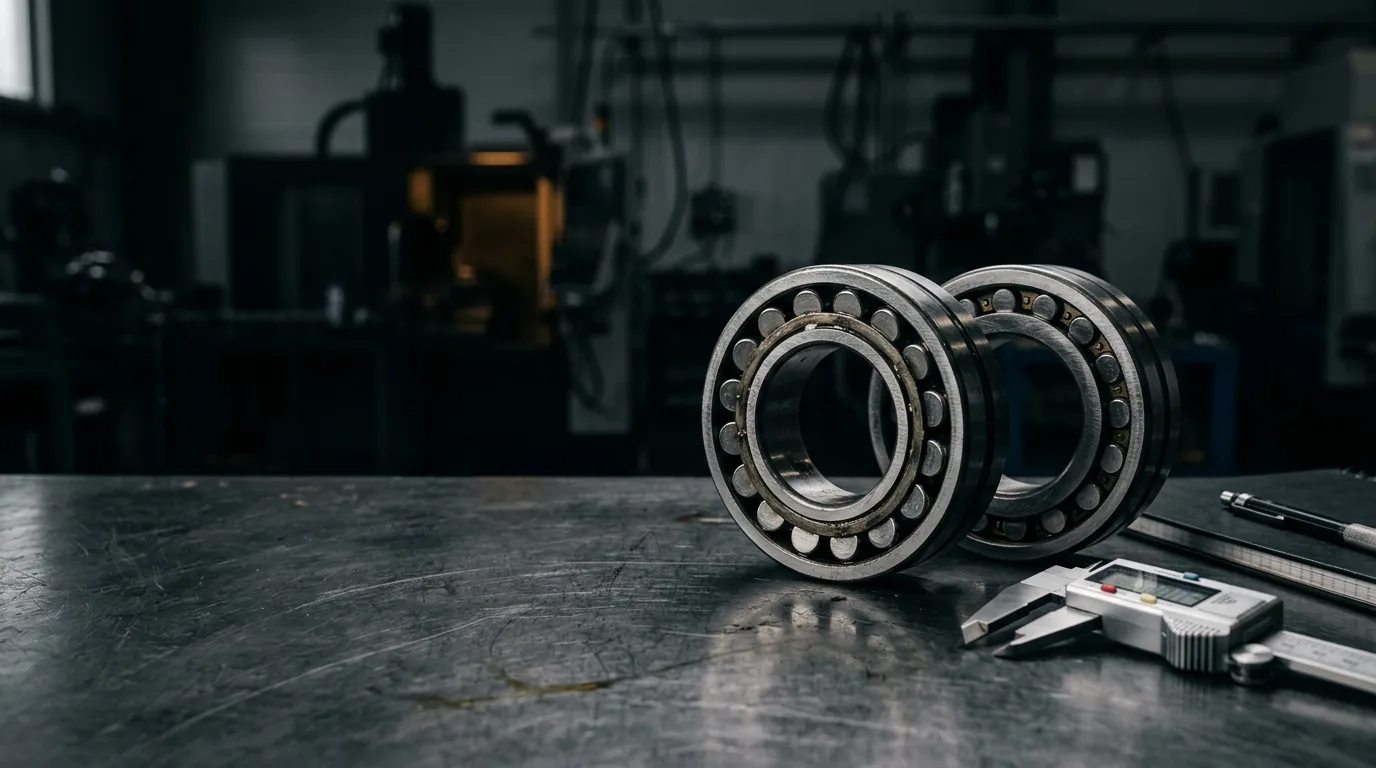
Spherical roller bearings are designed for heavy combined loads and high misalignment, while cylindrical roller bearings excel at high-speed, heavy radial loads without misalignment. The choice between the two dictates the lifespan and reliability of industrial machinery. Standard spherical designs can accommodate angular misalignment of 0.5° to 2° depending on the series[1][2], whereas cylindrical bearings demand near-perfect alignment to function correctly[3][4].
Our team at HI-TEC BEARINGS frequently assists maintenance engineers in navigating this exact bearing selection process. This guide provides a technical breakdown of spherical vs cylindrical roller bearings, comparing load capacities, speed limits, and practical applications to ensure you specify the right component for your equipment.
What is the difference between spherical and cylindrical roller bearings?
The core difference between spherical and cylindrical roller bearings lies in their internal geometry and how they manage shaft deflection. Spherical roller bearings accommodate heavy loads and shaft misalignment simultaneously, whereas standard cylindrical roller bearings require strict alignment to prevent premature failure.
Spherical roller bearings feature barrel-shaped rollers that run inside a spherical outer raceway. This self-aligning geometry allows the inner ring to tilt without creating harmful edge loading on the rollers[2][3]. Because of this design, they easily absorb structural movement and shaft bending in heavy-duty machinery.
Conversely, cylindrical roller bearings utilize straight rollers operating in linear raceways. This maximizes the contact area, granting them an exceptionally high cylindrical roller bearing load capacity for pure radial forces. However, because they lack a spherical raceway, they are highly sensitive to misalignment; even minor angular deviations cause stress concentrations that lead to surface fatigue and rapid failure[3][4]. When navigating a bearing selection guide, engineers must prioritize alignment precision before specifying a cylindrical design.
When should I use a spherical roller bearing instead of a cylindrical one?
You should use a spherical roller bearing when the shaft is subject to deflection or angular misalignment that would cause a cylindrical bearing to fail prematurely. Cylindrical roller bearings are ideal for high-speed applications like electric motors, whereas spherical roller bearings are built for harsh environments like mining equipment.
To make the correct specification, compare their performance limits across key engineering criteria:
| Specification | Spherical Roller Bearings | Cylindrical Roller Bearings |
|---|---|---|
| Misalignment Tolerance | 0.5° to 2° typical (up to 1.5° for open designs)[1][2] | Effectively zero (requires strict alignment)[4] |
| Speed Limit Factor | ~200,000 N·dm (moderate speeds)[5] | Up to ~600,000 N·dm (high speeds)[5] |
| Load Type | Heavy radial and moderate axial (combined) loads | Heavy radial loads only (unless flanged) |
| Primary Applications | Crushers, paper mills, vibrating screens | Electric motors, gearboxes, machine tool spindles |
Because of their robust self-aligning capabilities, spherical roller bearings are the standard for heavy industrial applications where perfect alignment is impossible to maintain. If the environment is rigid, perfectly aligned, and demands high RPMs, cylindrical bearings are the superior choice due to their drastically higher speed limits and lower frictional torque[5][4].
How do I choose between spherical and cylindrical bearings for my application?
To choose between spherical and cylindrical bearings, you must systematically evaluate your machinery's shaft alignment, operating speed, and load direction. Following a structured assessment prevents catastrophic edge-loading failures or thermal overload.
- Assess the alignment of the shaft - if misalignment exceeds 0.5 degrees, spherical roller bearings are required. Sealed spherical designs safely handle 0.5° of static misalignment, while unsealed series can permit up to 1.5° or 2° under light loads[1][2]. Standard cylindrical roller bearings cannot accommodate these deviations[4].
- Determine the speed requirements - for high-speed applications with pure radial loads, select cylindrical roller bearings. Cylindrical designs offer speed limit factors up to roughly 600,000 N·dm, which is approximately three times higher than the 200,000 N·dm limit typical of spherical equivalents[5].
- Evaluate the load direction - choose spherical bearings if there are axial forces combined with heavy radial loads. Spherical roller bearing applications naturally support thrust loads in both directions alongside radial forces, whereas standard cylindrical bearings only support radial loads unless equipped with specific thrust flanges.
Frequently Asked Questions
What is the difference between spherical and cylindrical roller bearings?
Spherical roller bearings use barrel-shaped rollers in a curved raceway to self-align and handle combined loads in misaligned environments. Cylindrical roller bearings use straight rollers to support pure, heavy radial loads at much higher speeds, but require strict shaft alignment to prevent failure.
When should I use a spherical roller bearing instead of a cylindrical one?
Use a spherical roller bearing when your machinery experiences shaft deflection, structural movement, or unavoidable misalignment (typically between 0.5° and 2°). If the application demands high-speed rotation with rigid, perfect alignment, a cylindrical bearing is the correct choice.
Are spherical and cylindrical roller bearings interchangeable?
No, they are not interchangeable. Replacing a spherical bearing with a cylindrical one on a misaligned shaft will cause edge loading and rapid failure. Conversely, swapping a cylindrical bearing for a spherical one in a high-speed application will likely exceed the spherical bearing's lower thermal and speed limits.
Which bearing is best for high-speed electric motors?
Cylindrical roller bearings are the best choice for high-speed electric motors. They operate with very low frictional torque and can achieve speed limit factors up to 600,000 N·dm, significantly outperforming spherical designs in high-speed, purely radial applications.
References
- What is the misalignment tolerance of spherical roller bearings? - Blog. https://www.wxinggroup.com/blog/what-is-the-misalignment-tolerance-of-spherical-roller-bearings-2061077.html (2025-12-10)
- Spherical roller bearings | Schaeffler medias. https://medias.schaeffler.us/en/knowledge-center/rolling-bearings/spherical-roller-bearings (2014-01-01)
- Spherical vs Cylindrical vs Tapered Roller Bearings: Key Differences. https://www.nsk.com/am-en/tools-resources/knowledge-center/blog/spherical-roller-bearings/spherical-vs-other-roller-bearings/ (2026-01-14)
- Cylindrical Roller Bearings - an overview | ScienceDirect Topics. https://www.sciencedirect.com/topics/engineering/cylindrical-roller-bearings (2025-10-02)
- Bearing Speed Limits & Calculation - American Roller Bearing. https://www.amroll.com/speed-limits.html (2026-06-10)