

How to Read Bearing Numbers: 2026 Measurement Guide
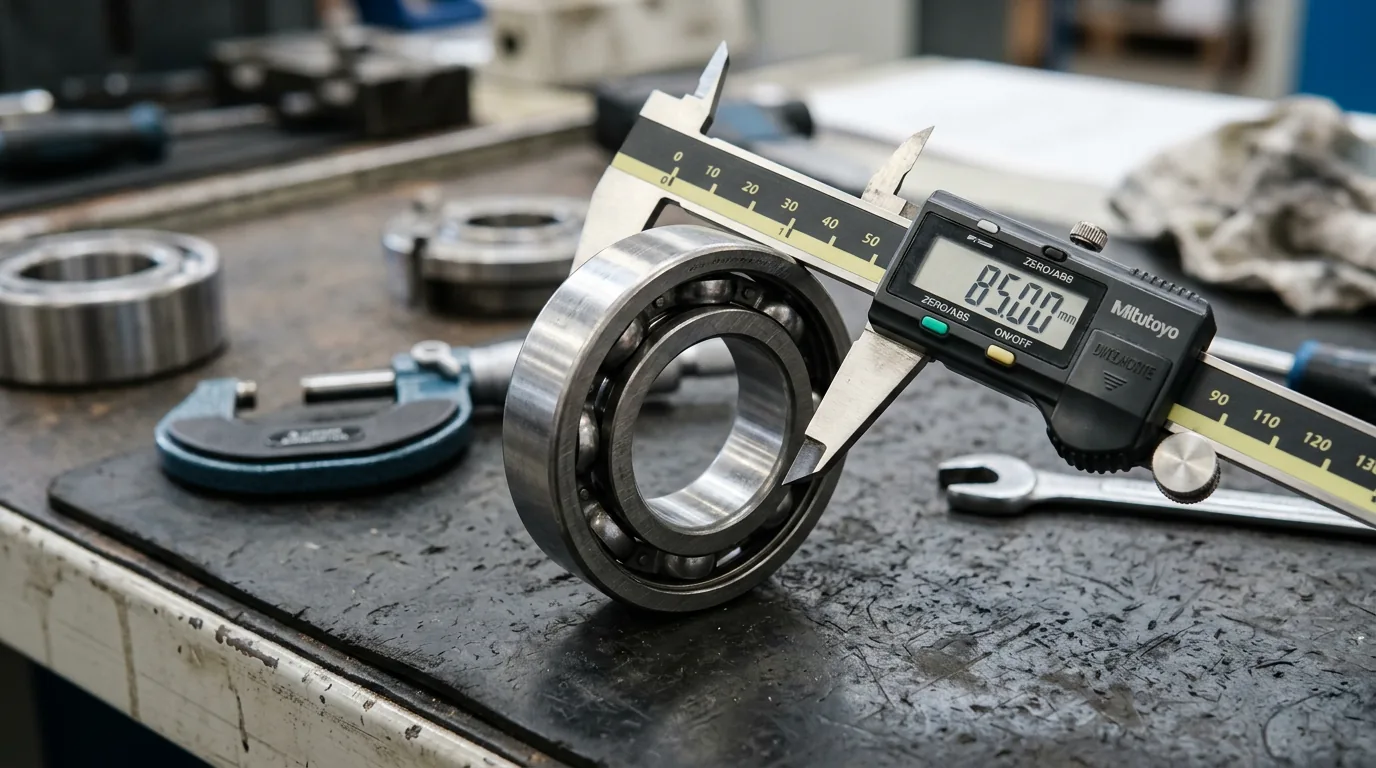
To read bearing numbers and accurately identify an unknown industrial bearing, engineers must measure three critical dimensions using digital calipers: the inside diameter (d), outside diameter (D), and width (B). Standard bearing part numbers, such as the widely used 6200 series, contain specific suffixes like 2RS or ZZ that indicate seal types and internal clearances. When bearing markings are worn off entirely, measuring these three core dimensions allows the HI-TEC BEARINGS technical team to accurately cross-reference and supply the correct replacement.
Understanding how to read bearing numbers is one of the most critical skills for any industrial maintenance professional. A single unmarked bearing can halt an entire production line, and guessing the replacement based on visual similarity often leads to catastrophic, premature failure. Industrial bearings are precision-engineered components with tolerances measured in micrometers. Installing a bearing with the incorrect internal clearance, the wrong seal type, or an unmatched load capacity will rapidly destroy the replacement and potentially damage the surrounding shaft and housing.
This comprehensive guide breaks down the exact precision tools required for bearing measurement, the step-by-step process for extracting accurate dimensional data, and the international ISO nomenclature system. Whether you are dealing with a standard metric 6200 series bearing, an imperial R-series component, or an entirely unmarked unit with a tapered bore, mastering these measurement and identification techniques ensures your machinery returns to peak operational efficiency safely and reliably.
What tools do I need to measure bearing dimensions?
Digital calipers are the primary tool required for measuring the critical dimensions of an industrial bearing, though precision micrometers and bore gauges are necessary for exact tolerance checks. When evaluating an unknown bearing, the accuracy of your measurement tools dictates whether you correctly identify the replacement or install a component that will fail prematurely under load.
Rolling bearings, particularly those conforming to ABEC or ISO precision classes, are manufactured with bore and outside diameter tolerances on the order of a few micrometers. For example, miniature and instrument bearings can feature bore tolerance limits as tight as -2.5 µm from the nominal size[1]. Standard ball bearings built to ABEC or ISO P6 specifications typically possess bore and outside diameter tolerances of ±5 to ±10 µm, depending entirely on the bearing's physical size[1][2]. To measure these dimensions reliably, our team adheres to the industry-standard 4:1 rule, which states that your measurement tool's uncertainty must be less than or equal to 25% of the part's total tolerance band[3].
While digital calipers are ubiquitous in maintenance environments, they typically offer an accuracy of ±0.02 to ±0.03 mm (±0.001 in)[4][5][6]. It is critical to distinguish between a tool's resolution and its accuracy; a caliper may display increments of 0.01 mm, but its true mechanical accuracy is closer to ±0.02 mm[4][3]. This level of precision is perfectly adequate for initial setup, rough comparative checks, or identifying the base series of an unmarked bearing, but it is marginal when verifying exact shaft fits or housing clearances where tolerances are exceptionally tight.
For precise verification, micrometers are required. Quality micrometers are approximately ten times more accurate than standard calipers, routinely offering ±0.001 to ±0.0025 mm (±0.00005 to ±0.0001 in) accuracy[4][7][5][6]. Outside micrometers should be used for the bearing's outside diameter and overall width, while internal micrometers or dedicated bore gauges are necessary for measuring the inner diameter[4][8][7]. For fully characterized bearings, where runout, complex geometries, and raceway curvatures must be verified, Coordinate Measuring Machines (CMMs) are the only practical solution for automated, repeatable measurements at 2.5 µm accuracy levels[8][9]. Furthermore, assessing the surface roughness of bearing raceways—which often feature sub-micron Ra values—requires contact stylus profilometers like a Talysurf or advanced optical interferometers[8]. Simple hand tools cannot capture these complex profiles.
The bearing must be thoroughly cleaned of grease, dirt, and rust before measurement to prevent fractional millimeter errors. Contaminants trapped on the raceways or ring faces will distort caliper readings, making a standard metric bearing appear to be a non-standard or imperial size. Following an industrial bearing maintenance and cleaning guide ensures that particulate matter does not interfere with the micrometer anvils. Furthermore, both the bearing and the measurement instruments must be allowed to equalize to room temperature to prevent thermal expansion from skewing the micrometer readings. Only when the bearing is pristine and thermally stable can you extract the precise dimensions required for accurate identification.
How do I measure an unknown industrial bearing?
To identify an unknown industrial bearing, engineers must measure three critical dimensions using digital calipers: the inside diameter (d), outside diameter (D), and width (B). Standard bearing dimension symbols dictate that 'd' represents the bore that fits onto the shaft, 'D' represents the outer diameter that fits into the machine housing, and 'B' represents the total axial width measured from one side face to the other[10][11].
Measuring an unknown bearing requires a systematic approach to ensure accuracy and to detect operational damage. Follow these precise steps:
- Measure the inner diameter (d): Use an internal micrometer, bore gauge, or the upper internal jaws of a high-quality digital caliper. Take readings in at least two axial planes (near each side face) and in two orthogonal directions (such as 0°–180° and 90°–270°) within each plane[10][12].
- Measure the outer diameter (D): Use an outside micrometer or the lower external jaws of a caliper across the outer ring. Ensure you do not accidentally measure across protruding rubber seals or metal shields. Take readings in at least two axial planes and two directions to assess both size and ovality[10][12].
- Measure the total width (B): Place the micrometer anvils axially across the bearing faces. Rotate the bearing relative to the tool to confirm that the side faces are perfectly square and have not suffered deformation[10]. For separable bearings like tapered rollers, measure the assembled width as defined in standard catalogs[10][11].
- Calculate total ovality: Take measurements at multiple points around the circumference to account for any uneven wear or ovality in the races. This multi-point method yields up to 16 data points per seat. Calculate the total ovality by subtracting the minimum measured diameter from the maximum[12]. Out-of-roundness of just 2.5 to 5 µm is often the absolute upper limit for precision journals and bores[13][14].
During this dimensional inspection, our team also checks for physical wear and damage in the races. Flaking or spalling on the raceway surface is a primary indicator of normal rolling contact fatigue, though excessive loads will accelerate this degradation[15]. You may also observe smearing, which indicates material transfer due to sliding under poor lubrication, or static vibration marks known as false brinelling[15].
A critical diagnostic sign is an oval wear pattern in the outer raceway—specifically, two wider wear paths located diametrically opposite each other. This oval compression indicates that the outer ring was forced into an out-of-round housing, causing dimensional distortion that calipers alone might miss before the bearing was extracted[15]. As noted by NSK, after examining raceways, cage wear, internal clearance, and tolerances, any significant spalling, cracking, severe indentation from solid particles, or loss of interference fit relative to the original specification generally dictates that the bearing cannot be reused and must be replaced[16][15][17].
By cross-referencing these precise multi-point measurements against a bearing dimension chart, maintenance engineers can confidently identify the exact replacement model required, even when the original markings have been completely obliterated by the operating environment.
How do I read a bearing number?
Standard bearing part numbers, such as the widely used 6200 series, contain specific digits that define the bearing type and duty series, while the final digits indicate the precise bore size. The international ISO bearing numbering system uses a structured alphanumeric designation to standardize dimensions across all major global manufacturers, ensuring that a bearing from one brand will dimensionally match the exact same part number from another[18][19][20].
The fundamental structure of a basic bearing number begins with the type code, which identifies the bearing's design. For instance, a '6' denotes a single-row deep groove ball bearing, while a '2' denotes a spherical roller bearing[21][18][22]. This is immediately followed by the dimension series, which is a combination of the width series and the diameter series[23][21]. The dimension series defines the bearing's overall robustness and cross-sectional profile; for example, in the '62' series, the '2' indicates a specific standard width and outer diameter proportion for that class of bearing, making it heavier-duty than a '60' series but lighter than a '63' series[23][18].
The final two digits of a standard bearing number indicate the bore size code, which can be multiplied by five to find the inside diameter in millimeters for codes 04 and above. This mathematical rule applies consistently to standard metric rolling bearings from bore codes 04 up to 96, covering internal diameters from 20 mm all the way up to 480 mm[21][18][19]. For example, a bearing ending in '04' (like a 6204) has a 20 mm bore (04 × 5 = 20)[22][24][25]. A bearing ending in '06' (like a 6006) features a 30 mm bore, and a 6010 features a 50 mm bore[22][24][25].
However, the ISO system utilizes a fixed, standardized mapping for the smallest bore sizes, rather than the multiplication rule. These specific codes represent legacy standard shaft sizes that were established early in industrial manufacturing:
- A bore code of 00 corresponds to a 10 mm inside diameter[18][24][26].
- A bore code of 01 corresponds to a 12 mm inside diameter[18][24][26].
- A bore code of 02 corresponds to a 15 mm inside diameter[18][24][26].
- A bore code of 03 corresponds to a 17 mm inside diameter[18][24][26].
There are exceptions to these standard rules that engineers must recognize. Bores smaller than 10 mm are typically written directly into the bearing number without a zero prefix; for instance, a common 608 bearing simply features an 8 mm bore[24]. Furthermore, non-standard bore sizes that do not fall into exact 5 mm increments are indicated in the designation separated by a slash, such as '/22' for a 22 mm bore or '/500' for a massive 500 mm bore[21][19]. Inch-series bearings completely bypass the ISO metric bore code, indicating their bore directly in inch dimensions[25].
Understanding this standardized logic through a bearing bore size guide allows engineers to instantly decode the physical structure of almost any metric bearing without needing to measure it first.
What do bearing suffixes like 2RS and ZZ mean?
Standard bearing part numbers contain specific suffixes like 2RS or ZZ that indicate seal types and internal clearances, alongside other critical design features such as cage materials. While the basic bearing number dictates the physical dimensions, the suffixes define the bearing's operational characteristics, environmental protection, and thermal tolerance limits.
| Suffix | Meaning | Function and Application |
|---|---|---|
| 2RS | Double rubber seals | Contact seals on both sides. Provides excellent exclusion of dust and moisture, but generates slightly higher friction[27][28]. |
| ZZ (or 2Z) | Double metal shields | Non-contact gap seals on both sides. Allows higher speeds and lower friction, but offers less protection against fine liquids[29][27][28]. |
| C3 | Increased internal clearance | Radial internal clearance greater than normal (CN/C0). Accommodates thermal expansion and heavy press fits without preloading[30][31][28]. |
| M | Machined brass cage | Solid brass cage guided by rolling elements. Offers superior rigidity, shock resistance, and high-temperature performance[32][33][34]. |
Selecting the correct suffix is vital because choosing a shielded bearing (ZZ) instead of a sealed bearing (2RS) in a wet environment can lead to rapid failure. A 'ZZ' or '2Z' bearing features non-contact metallic shields that protect against larger particles and retain grease, but the microscopic labyrinth gap between the shield and the inner ring allows water and fine dust to penetrate[29][27][28]. Conversely, a '2RS' bearing utilizes rubber contact seals that physically rub against a recess in the inner ring, creating a tight physical barrier against moisture at the cost of slightly reduced maximum speeds and higher operating temperatures[27][28].
The internal clearance suffix is equally critical for machine survival. Bearing internal clearance is the total distance one ring can move relative to the other in the unmounted state, either radially or axially[35][36]. Standard clearance is designated as CN or C0 and is often omitted from the part number[30][37]. However, the 'C3' suffix indicates a radial internal clearance greater than normal[31][28]. Engineers specify C3 bearings for applications involving high operating temperatures, steam-heated shafts, or tight interference fits on both rings[30][38]. Without this extra initial clearance, thermal expansion would cause the bearing to operate with negative clearance (preload), leading to excessive friction, extreme heat generation, and catastrophic failure[30][36]. Beyond C3, the clearance scale includes C4 and C5 for even larger clearances, and C2 for tighter-than-normal fits[39][31][28].
Finally, cage material suffixes like 'M' denote a machined or solid brass cage[32][28]. Compared to standard pressed-steel cages, machined brass cages provide higher load capacity, superior structural rigidity, and better behavior under heavy shock or vibration[33][34][40]. Variants such as 'MA' or 'MB' further specify how the brass cage is guided within the bearing; an 'MA' suffix indicates guidance on the outer ring rib, while 'MB' indicates guidance on the inner ring rib[29][41]. When reading a complex part number like 6205-2RS C3 M, our team knows immediately that it is a 25 mm bore bearing with double rubber seals, increased internal clearance, and a heavy-duty brass cage. For detailed selection assistance, always consult a comprehensive bearing seal and shield selection guide.
How do I identify a bearing with no markings?
When bearing markings are worn off, measuring the three core dimensions allows the HI-TEC BEARINGS technical team to accurately cross-reference and supply the correct replacement. In harsh industrial environments—such as mining operations, paper mills, or chemical plants—bearings are subjected to extreme contamination, caustic washdowns, and micro-vibrations that cause fretting corrosion. These environmental factors frequently obliterate the manufacturer's stamped or laser-etched part numbers on the outer ring, leaving maintenance engineers with a completely blank component.
To identify an unmarked bearing, engineers must systematically evaluate the following criteria:
- Inside diameter (d): The bore size dictates the shaft fit. Measure in multiple planes with an internal micrometer to account for any wear or dimensional loss on the inner ring.
- Outside diameter (D): The outer dimension dictates the housing fit. Measure across the outer ring to establish the primary boundary dimension.
- Width (B): The total axial width ensures the bearing will seat correctly without interfering with snap rings or end covers.
- Visual design features: Identifying physical characteristics like the presence of a snap ring groove or a tapered bore helps narrow down the exact replacement model[42].
One of the most common visual identifiers is the snap ring groove, denoted by the suffix 'NR' (Snap Ring groove and snap ring)[25][43][42]. If you observe a continuous machined circumferential groove near one side of the outer ring, the bearing requires an NR suffix[44][45]. This groove is designed to hold a C-shaped retaining ring (circlip) that protrudes from the bearing, acting as an axial stop against the machine housing to prevent the bearing from walking out of position[44]. The JIS B 1509 standard strictly defines these groove dimensions relative to the bearing's nominal bore, outside diameter, and width[45]. Even if the snap ring itself has been lost or destroyed during a catastrophic failure, the presence of the machined groove is a definitive identification marker[44][42].
Another critical feature is a tapered bore, indicated by the suffix 'K'[25][43][42]. While standard bearings feature a straight, cylindrical bore, a K-type bearing has a bore diameter that increases slightly from one face to the other, typically at a 1:12 taper ratio[25][43]. This K-type taper is predominantly found on spherical roller bearings and specific cylindrical roller bearings used in heavy machinery[25][43]. A bearing with a tapered bore does not slide freely over a straight shaft; instead, it is driven axially up a tapered adapter sleeve or a tapered shaft journal[25][42]. This axial displacement expands the inner ring slightly to achieve a precise interference fit while simultaneously setting the final internal clearance[25][43]. Some specific bearings utilize a 1:30 taper ratio, which is denoted by the suffix 'K30'[25][43].
By accurately measuring the core boundary dimensions and noting specific design features like NR grooves or K tapers, you provide the exact data required for the HI-TEC BEARINGS technical support team to cross-reference standard catalogs, decode the lost suffixes, and procure the correct unit.
How do I use a bearing size chart for cross-referencing?
A bearing size chart allows you to match your measured inside diameter, outside diameter, and width directly to standard industry part numbers. Because different bearing series can share identical bore sizes but feature vastly different outer dimensions and load capacities, cross-referencing your precision measurements against a standardized chart is the only way to guarantee a correct and safe replacement[22][46].
A comprehensive size chart presents the basic boundary dimensions alongside critical performance metrics, including the dynamic load rating (Cr) and the static load rating (Cor)[22][47][48]. The dynamic load rating represents the basic radial load capacity that a bearing can endure for a calculated operational life, while the static load rating represents the maximum load a stationary bearing can withstand before permanent plastic deformation occurs on the raceways[22][47][48][49]. For example, a standard 6004 metric bearing has a 20 mm bore, 42 mm outside diameter, and 12 mm width[48][47]. If your application requires a heavier-duty component for the same 20 mm shaft, the chart will direct you to the 6304 series, which features a much larger 52 mm outside diameter and 15 mm width, providing significantly higher load capacity[47][49].
| Measurement System | Common Series | Dimension Format | Example Bore Size |
|---|---|---|---|
| Metric | 6000, 6200, 6300 | Millimeters (mm) | 6004 = 20 mm[48][47] |
| Imperial | R-Series, RMS | Fractional Inches (in) | R4 = 0.2500 in (1/4")[50] |
If your measurements do not match standard metric charts, the bearing may be an imperial size, requiring conversion to fractional inches. Imperial bearings are manufactured to exact inch dimensions and are common in legacy North American machinery. The most prevalent imperial standard is the R-series[50][51]. For instance, an R4 bearing features a 0.2500-inch (1/4") bore, a 0.6250-inch (5/8") outside diameter, and a 0.1960-inch width for the open variant[50]. If an engineer measures a bore of 9.525 mm, it will not align with any standard ISO metric code; however, converting that measurement to 0.3750 inches (3/8") immediately identifies it as an R6 imperial bearing[50][52]. Imperial R-series bearings are produced to strict ABEC 1, 3, 5, or 7 tolerance classes and are supplied in open, shielded, or sealed configurations[50].
Modern cross-referencing often requires converting between systems because many inch-series bearings are cataloged with an imperial bore but metric outer dimensions, allowing them to adapt inch shafts to metric housings[53][51]. Bearing suppliers publish specialized conversion charts that list metric and imperial boundary dimensions side by side, ensuring engineers can identify exact matches within strict tolerance bands[54][55][56]. For example, an imperial part designated as KLNJ3/16 or R3 features dimensions of 3/16" × 1/2" × 5/32"; this can be compared directly against metric miniatures in comprehensive charts to evaluate substitution possibilities[57][56].
While a bearing cross reference chart is an invaluable tool for dimensional matching, our engineers stress that physical dimensions are only the starting point. Before finalizing a substitution, you must verify that the new bearing's tolerance class, internal clearance (such as C3), and cage material meet or exceed the original equipment manufacturer's specifications[58][46][50]. Relying strictly on a dimensional match without verifying load ratings can lead to increased friction, overheating, and premature machine failure[46][22].
Frequently Asked Questions
How do I read a bearing number?
To read a standard metric bearing number, identify the prefix for the type and series (e.g., 62 for a deep groove ball bearing), then look at the final two digits for the bore code. For codes 04 and above, multiply the final two digits by five to find the inside diameter in millimeters (e.g., 6204 has a 20 mm bore). Look for suffixes like 2RS or ZZ to identify seal types.
What do bearing suffixes like 2RS and ZZ mean?
The suffix 2RS indicates that the bearing has rubber contact seals on both sides, providing excellent protection against moisture and fine dust. The suffix ZZ (or 2Z) indicates metal non-contact shields on both sides, which allow for higher running speeds and lower friction but offer less protection against liquid contamination.
How do I identify a bearing with no markings?
To identify an unmarked bearing, use a digital caliper or micrometer to measure the inside diameter, outside diameter, and total width. Next, check for specific physical features like a snap ring groove on the outer ring (NR suffix) or a tapered bore (K suffix). Cross-reference these exact dimensions and features with a standard bearing size chart to find the replacement.
What tools do I need to measure bearing dimensions?
You need digital calipers for initial rough measurements and identifying the base series of the bearing. However, for exact tolerance checks on the inside and outside diameters, you must use precision outside micrometers and internal bore gauges, which offer significantly higher accuracy (±0.001 mm) required for verifying ABEC/ISO bearing fits.
References
- Tolerances | New Hampshire Ball Bearings, Inc.. https://www.nhbb.com/index.php/knowledge-center/engineering-reference/miniature-instrument-bearings/tolerances (2026-03-19)
- [PDF] NTN-Bearing-Tolerance-Tables.pdf. https://ntnamericas.com/wp-content/uploads/2020/04/NTN-Bearing-Tolerance-Tables.pdf (2026-06-24)
- caliper vs micromiter. : r/Machinists - Reddit. https://www.reddit.com/r/Machinists/comments/vcbpmb/caliper_vs_micromiter/ (2022-06-14)
- Micrometers vs Calipers: Understand the Key Differences. https://www.reidsupply.com/en-us/industry-news/micrometers-vs-calipers-key-differences (2026-06-25)
- Precision Measurement Tools Primer | Starrett. https://www.michelli.com/precision-measurement-tools-primer-starrett/ (2022-02-15)
- What's the difference between calipers and micrometers - Dasqua. https://www.dasquatools.com/news/whats-the-difference-between-calipers-and-micrometers/ (2025-01-01)
- Micrometers vs Calipers: Which Tool Best Fits Your Measurement .... https://daitool.com/blogs/daitool-blog/micrometers-vs-calipers-which-tool-best-fits-your-measurement-needs (2024-12-26)
- Best methods for bearing measurements : r/Metrology - Reddit. https://www.reddit.com/r/Metrology/comments/1aepjcb/best_methods_for_bearing_measurements/ (2024-01-30)
- What is precision measuring tools? - Sumble. https://sumble.com/tech/precision-measuring-tools (2026-06-04)
- Understanding Bearing Dimensions and Sizes - the Tuli shop. https://www.tuli-shop.com/blog/understanding-bearing-dimensions-and-sizes.html (2024-08-01)
- Basic Dimensions - New Hampshire Ball Bearings, Inc.. https://www.nhbb.com/knowledge-center/engineering-reference/miniature-instrument-bearings/basic-dimensions (2026-02-06)
- Bearing Inspection Procedures Guide | PDF - Scribd. https://www.scribd.com/document/578119435/Inspection-Monitoring-Bearings (2025-09-01)
- How to Set and Check Bearing Clearance - MotorTrend. https://www.motortrend.com/how-to/1902-how-to-set-and-check-bearing-clearance (2019-02-26)
- How to Measure your Crankshaft Part 1- Ovality and Taper - YouTube. https://www.youtube.com/watch?v=be6M3pwjuos (2016-06-13)
- Troubleshooting premature bearing failure - Reliabilityweb. https://reliabilityweb.com/articles/entry/troubleshooting_premature_bearing_failure (2009-03-07)
- Bearing Inspection | NSK Global. https://www.nsk.com/tools-resources/mantenance/bearing-inspection/ (2024-07-11)
- General Bearing Handling And Inspection - Reliabilityweb. https://reliabilityweb.com/articles/entry/general_bearing_handling_and_inspection (2009-09-21)
- [PDF] 1. ISO Dimensional system and bearing numbers. https://bearing.co.il/wp-content/uploads/2024/11/nsk_cat_e728g_1.pdf (2025-04-24)
- [PDF] Bearing dimensions and designations - NSK. https://www.nsk.com/content/dam/nsk/eu/en_gb/documents/bearings-europe/P_TI-0111_EN.pdf (2026-03-10)
- ISO 5593:2023(en), Rolling bearings — Vocabulary. https://www.iso.org/obp/ui/en/ (2025-11-22)
- Basic Designation System of Rolling Bearings | Bore Code - YouTube. https://www.youtube.com/watch?v=3VR9k516kE8 (2025-08-09)
- Ball Bearing Size Chart: 6000, 6200, 6300, 6800, and 6900 Series. https://iskbearing.com/news/knowledge/the-ball-bearing-size-chart (2026-06-17)
- Bearing Designation System - How to identify a Bearing - YouTube. https://www.youtube.com/watch?v=XLhas6Z7Xto (2023-12-13)
- How Do You Measure a Bearing? A Step-by-Step Guide. https://www.andebearing.com/blog/how-to-measure-a-bearing (2026-05-13)
- [PDF] Bearing and Linear Reference Guide | NSK. https://www.nsk.com/content/dam/nsk/am/en_us/documents/bearings-americas/Bearing-and-Linear-Reference-Guide.pdf (2026-06-20)
- Bearing data - Schaeffler medias. https://medias.schaeffler.co.uk/en/knowledge-center/rolling-bearings/bearing-data (2026-06-07)
- Bearing Prefixes and Suffixes and What They Mean.. https://bearingsdirect.com/blog/bearing-prefixes-and-suffixes-and-what-they-mean/ (2023-02-20)
- BEARING SUFFIX CODES - MicroBlue Bearings. https://www.microbluebearings.com/bearing-suffix-codes/ (2026-06-08)
- FAG bearing designation | nomenclature | prefix | suffix. https://www.nodeshk.com/fag/art/fag-bearing-designation.html (2025-09-24)
- Bearing Internal Clearance. https://blog.emersonbearing.com/blog/bearing-internal-clearance (2024-06-07)
- Bearing Designation Suffixes Explained | PDF - Scribd. https://www.scribd.com/document/414238077/Bearing-Designation-Numbers-Suffex (2025-09-25)
- Designation system - SKF. https://www.skf.com/us/products/rolling-bearings/ball-bearings/deep-groove-ball-bearings/designation-system
- SKF bearing suffix codes. https://www.nodeshk.com/skf/art/skf-bearing-suffix-codes.html (2026-03-16)
- Designation system | SKF. https://www.skf.com/us/products/rolling-bearings/roller-bearings/spherical-roller-bearings/designation-system
- [PDF] Internal Clearance-Types and Norms - NSK. https://www.nsk.com/content/dam/nsk/am/en_us/documents/bearings-americas/TI%20Internal%20Clearance.pdf (2026-06-23)
- Internal clearance | SKF. https://www.skf.com/us/products/rolling-bearings/principles-of-rolling-bearing-selection/general-bearing-knowledge/bearing-basics/internal-clearance
- [PDF] BEARING DESIGNATION SYSTEMS - NSK. https://www.nsk.com/content/dam/nsk-marketing/projects-completed/literature/service/bearing-designation-systems_bochure/en_bearing-designation-systems_bochure/preview-pdf_bearing-designation-systems_bochure_en/EN_Bearing_Designation_Systems_BD_03_2024_low-res.pdf (2026-06-24)
- Bearing designation - Open Source Ecology wiki. https://wiki.opensourceecology.org/wiki/Bearing_designation (2022-01-26)
- Bearing number | Basic Bearing Knowledge - ジェイテクト. https://koyo.jtekt.co.jp/en/support/bearing-knowledge/6-3000.html (2026-06-24)
- Small Codes, Big Meaning* ⚙️ *Key Suffixes Decoded:* *ZZ/2Z .... https://www.facebook.com/61569683218141/posts/%EF%B8%8F-bearing-suffix-codes-small-codes-big-meaning-%EF%B8%8Fkey-suffixes-decodedzz2z-metal-s/122167132700656107/ (2026-05-11)
- FAG bearing designation | nomenclature | prefix | suffix. https://kapent.com/fag-bearing-designation-nomenclature-prefix-suffix/ (2021-03-29)
- How To Read Bearing Numbers And What To Do When The .... https://industrial-now.net/how-to-read-bearing-numbers-and-what-to-do-when-the-marking-is-no-longer-visible/ (2025-12-05)
- [PDF] Bearing Nomenclature Guide - BDS Bearing. https://www.bdsbearing.com/hubfs/Bonus%20Content/BDS-Bearing%20Book-2023.pdf (2026-06-25)
- Snap (Retaining) Rings to Create a Shoulder to Keep an Assembly .... https://www.bmcbearing.com/blog/snap-rings (2021-08-05)
- Dimensions of snap ring grooves and locating snap rings. https://koyo.jtekt.co.jp/en/support/bearing-knowledge/6-2000.html (2023-12-01)
- Deep groove ball bearings | SKF. https://www.skf.com/us/products/rolling-bearings/ball-bearings/deep-groove-ball-bearings
- BALL BEARINGS SIZE CHART - MROSupply.com. https://www.mrosupply.com/blog/ball-bearings-size-chart/ (2026-06-24)
- Bearing Sizes. https://www.bearingworks.com/bearing-sizes/ (2026-03-07)
- METRIC SIZE CHARTS - MicroBlue Bearings. https://www.microbluebearings.com/pages/METRIC-SIZE-CHARTS.html (2026-02-24)
- R Series | Specialty and Precision Bearings - Schatz Bearings. https://schatzbearing.com/precision-bearings/r-series/ (2024-01-08)
- [PDF] Imperial Premium Ball Bearings - the Finer Power Transmissions. https://www.finerpt.com/site/DefaultSite/filesystem/documents/Finer%20Catalogue%20Files/Bearings/Ball%20Bearings/Deep%20Groove%20Ball%20Bearings/Imperial%20Series%20DG%20Ball%20Bearings/DGBB%20Premium%20Inch%20Series.pdf (2025-11-02)
- Imperial to Metric Conversion Table - Plaig Bearings. https://plaig.com.au/resources/imperial-metric-conversion-table/
- Metric Ball Bearings - Bearings Direct. https://bearingsdirect.com/metric-ball-bearings/ (2026-04-23)
- deep groove ball bearing size conversion chart. https://egibearing.com/deep-groove-ball-bearing-size-conversion-chart/ (2025-05-20)
- Bearing Conversion Charts - Farrell Bearings. https://www.farrellbearings.co.nz/Technical+Resources/Bearing+Conversion+Charts.html (2025-09-24)
- [PDF] single row deep groove ball bearings. http://www.bearing.net.au/wp-content/uploads/2014/10/Binder122.pdf
- Standard Imperial (Inch) Ball Bearings - Henderson Bearings. https://www.hendersonbearings.co.uk/deep-groove-ball-bearings/standard-imperial-inch-ball-bearings.html (2024-11-01)
- SKF Bearing Size and Dimension Chart | PDF - Scribd. https://www.scribd.com/document/248707361/Bearing-Size-Chart (2026-06-15)