

Deep Groove vs. Angular Contact Bearings: 2026 Selection Guide
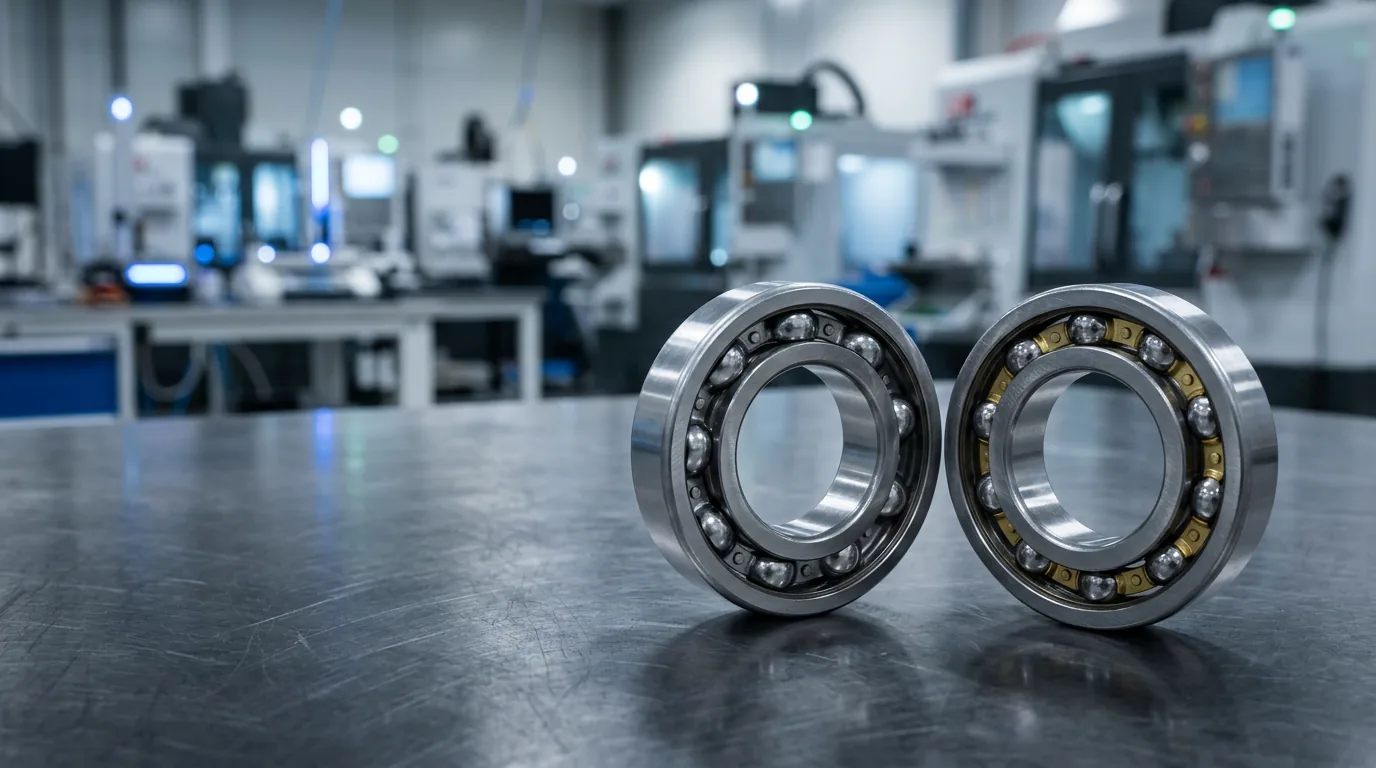
When comparing deep groove vs angular contact ball bearings, the core difference lies in load direction. Deep groove ball bearings handle high-speed radial loads, while angular contact bearings are engineered to support combined radial and unidirectional axial thrust loads. For standard electric motors, engineers select deep groove designs, whereas precision machine tool spindles require angular contact bearings to manage high RPMs and thrust forces.
This guide breaks down the technical differences in load capacities, speed ratings, and internal clearances. Proper selection ensures maximum service life and prevents premature failure across industrial applications.
What is the difference between deep groove and angular contact bearings?
Deep groove ball bearings handle high-speed radial loads, while angular contact bearings are engineered to support combined radial and unidirectional axial thrust loads. Deep groove designs use standard internal clearance, whereas angular contact bearings feature a specific contact angle that requires preloading.
Deep groove bearings are fundamentally radial bearings. While their deep raceway grooves allow them to accept axial loads in both directions, continuous axial loads should generally be limited to about 20-25% of the bearing's basic static load rating (C₀)[1]. Exceeding this limit reduces the bearing's service life significantly[1][2]. Our team supplies a wide range of deep groove ball bearings to suit these standard radial load requirements.
Conversely, angular contact bearings are manufactured with a built-in contact angle, shifting the load path to support heavy axial forces. Globally common standard contact angles are 15°, 25°, 30°, and 40°[3][4][5]. Smaller angles (15° - 25°) are optimized for high-speed operation with lighter axial loads, while larger angles (30° - 40°) provide higher axial load capacity and stiffness at lower maximum speeds[6][7].
Deep Groove vs. Angular Contact: How do they compare on load and speed?
Deep groove bearings excel at high-speed radial loads but have limited axial capacity, whereas angular contact bearings excel at combined loads in one direction. The correct choice depends entirely on the application's dominant forces and operating speeds.
HI-TEC BEARINGS provides technical selection support and maintains a 2,000-SKU inventory of both deep groove and angular contact ball bearings for same-day dispatch. Comparing their technical specifications helps maintenance engineers identify the optimal solution.
| Specification | Deep Groove Ball Bearings | Angular Contact Ball Bearings |
|---|---|---|
| Primary Load Direction | Radial | Combined (Radial + Unidirectional Axial) |
| Axial Load Capacity | Limited (≤ 25% of static radial load C₀)[1] | High (increases with larger contact angle)[3][5] |
| Speed Rating | Very High | High to Very High (smaller angles allow higher speeds)[6] |
| Internal Clearance | Positive (e.g., standard or C3)[8][9] | Negative (requires precise axial preload)[10][11] |
| Typical Applications | Electric motors, standard gearboxes, pumps | Machine tool spindles, heavy machinery, robotics[6][7] |
How do I choose between deep groove and angular contact bearings?
For standard electric motors, engineers select deep groove designs, whereas precision machine tool spindles require angular contact bearings to manage high RPMs and thrust forces. Selection depends on load profile, speed requirements, and mounting configurations.
Unlike deep groove designs that use standard C3 internal clearances, angular contact ball bearings require precise preloading during installation to prevent premature failure. When evaluating bearing technical selection support criteria, engineers must assess the following factors:
- Check the load profile: If the application generates primarily radial forces with minimal axial thrust, a deep groove bearing is sufficient. If heavy axial forces are present, angular contact bearings are required.
- Evaluate internal clearance vs. preload: Deep groove C3 bearings feature increased radial internal clearance to accommodate thermal expansion or shaft deflection[8][12]. In contrast, angular contact bearings require a defined axial preload (often 1-2% of the dynamic load rating) to remove internal play[13].
- Understand preload benefits: Applying the correct preload to an angular contact bearing doubles to triples its axial stiffness[10]. This continuous contact prevents rolling elements from skidding, which eliminates smearing damage and extends bearing life[14][15].
- Consider mounting arrangements: Angular contact bearings only support axial loads in one direction. If bidirectional thrust is present, they must be mounted in back-to-back or face-to-face pairs[10][11].
Frequently Asked Questions
What is the difference between deep groove and angular contact bearings?
Deep groove ball bearings are designed primarily for high-speed radial loads, while angular contact bearings feature a built-in contact angle to support combined radial and unidirectional axial loads.
Can a deep groove ball bearing take an axial load?
Yes, but only to a limited extent. Continuous axial loads on a deep groove ball bearing should typically not exceed 20-25% of its basic static load rating (C₀)[1]. For heavier axial thrust, an angular contact bearing is required.
How do I choose between a radial and an angular contact bearing?
Choose a radial deep groove bearing for applications like standard electric motors where radial forces dominate. Select an angular contact bearing for applications like precision spindles that generate significant axial thrust and require high rigidity.
What are the applications of an angular contact ball bearing?
Angular contact ball bearings are used in applications requiring high axial stiffness and combined load support. Common industrial uses include machine tool spindles, heavy-duty gearboxes, industrial pumps, and robotics[6][7].
References
- Loads | SKF. https://www.skf.com/us/products/rolling-bearings/ball-bearings/deep-groove-ball-bearings/loads
- Deep Groove Ball Bearings - an overview | ScienceDirect Topics. https://www.sciencedirect.com/topics/engineering/deep-groove-ball-bearings (2025-10-01)
- [PDF] Angular Contact Ball Bearings - NTN Global. https://www.ntnglobal.com/en/products/catalog/pdf/2203E_b04.pdf (2026-06-04)
- Angular Contact Ball Bearings | NSK Americas. https://www.nsk.com/am-en/products/bearings/ball-bearings/angular-contact-ball-bearings/ (2024-07-02)
- Characteristics of an Angular Contact Ball Bearing. https://www.gmnbt.com/resources/guides/ball-bearing/the-anatomy-of-angular-contact-bearings/ (2023-01-01)
- Understanding Bearing Contact Angle in Angular Contact Ball .... https://www.ritbearing.com/blog/archive/understanding-bearing-contact-angle-in-angular-contact-ball-bearings/ (2026-01-27)
- Angular Contact Bearing Arrangement Selection - YouTube. https://www.youtube.com/watch?v=LCfsOMVb_jM (2023-11-20)
- C3 Clearance Deep Groove Ball Bearings: When to Use Them?. https://fytzbearing.com/c3-clearance-deep-groove-ball-bearings-when-to-use-them/ (2025-07-01)
- Bearing Internal Clearance: C3 vs. CN & ISO Charts | TFL. https://tflbearing.com/blog/understanding-the-importance-of-bearing-clearance.html (2021-12-02)
- 8—Preload | NSK Global. https://www.nsk.com/tools-resources/abc-bearings/preload/ (2024-07-11)
- [PDF] Bearing preload | SKF. https://www.skf.com/binaries/pub12/Images/0901d1968065f1f4-Bearing-preload_tcm_12-299896.pdf (2026-06-23)
- Understanding C3 Bearing: A Beginner's Guide to Internal Clearance. https://iskbearing.com/news/knowledge/understanding-c3-bearings-an-essential-guide-to-precision-in-machinery (2025-12-11)
- Angular Contact Bearing Preload and Bearing Internal Clearance. https://www.youtube.com/watch?v=lSiTwOUh-mU (2023-11-29)
- A Technical Guide-Preload in Angular Contact Ball Bearings. https://www.zys-bearing.com/news-technical-articles/a-technical-guide-preload-in-angular-contact-ball-bearings.html (2025-04-11)
- Preload and Duplex Bearings | New Hampshire Ball Bearings, Inc.. https://www.nhbb.com/index.php/knowledge-center/engineering-reference/ball-roller-bearings/preload-duplex-bearings (2026-06-19)