

Causes of Bearing Failure: Inside the 5-Stage Cascade (2026)
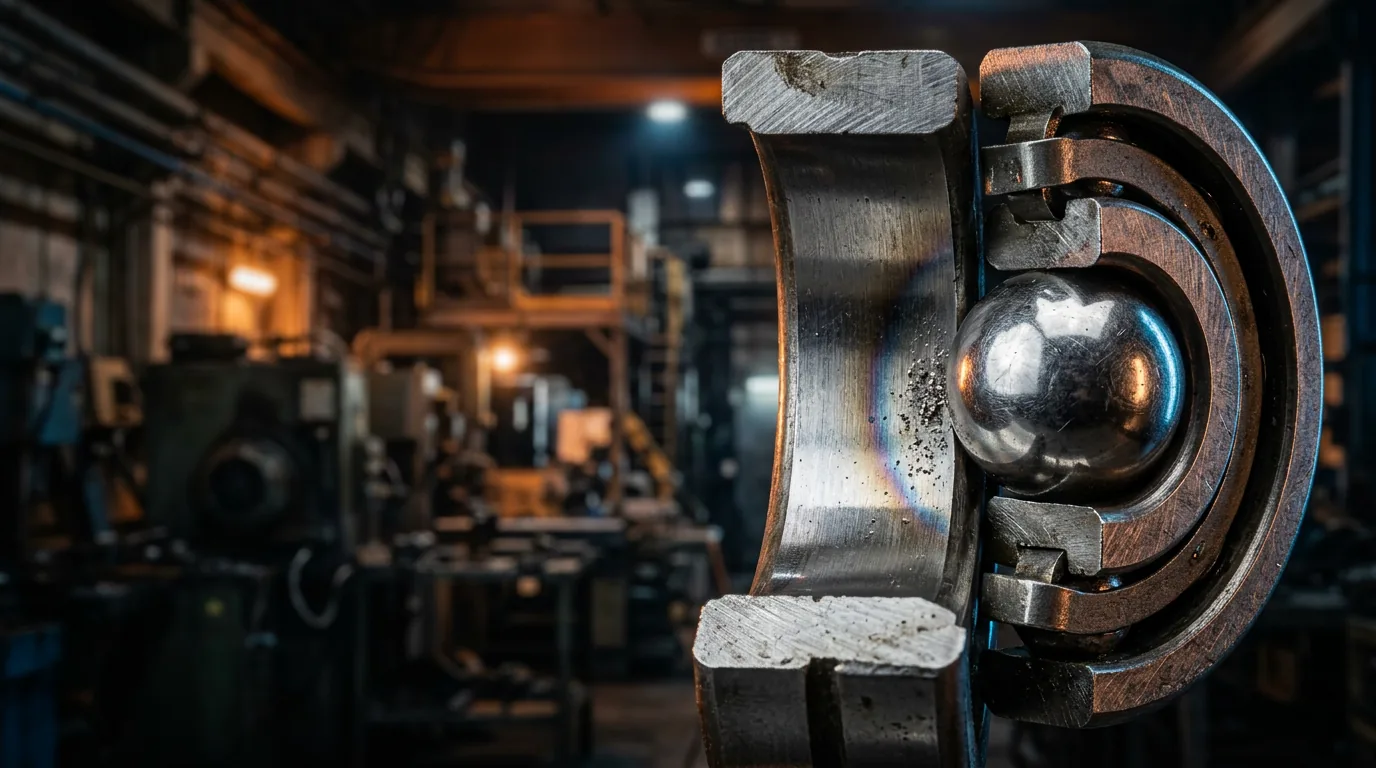
A bearing doesn't just break. It dies in five stages. The causes of bearing failure are not random events; they are preventable mechanical progressions stemming from improper specification, poor lubrication, or counterfeit components. In industrial environments across Pakistan, understanding these root causes prevents catastrophic machine downtime.
When a bearing fails, it follows a predictable cascade: initial micro-pitting, escalating heat generation, rapid clearance loss, and eventual seizure. Recognizing this progression transforms maintenance into a predictable science. Too often, buyers assume failure is an inevitable consequence of heavy industrial loads. In reality, it is almost always a symptom of a mismatched component or a compromised operating environment.
For over 60 years, HI-TEC Bearings has engineered solutions for Pakistan's manufacturing sectors, proving that proper clearance, precise ball grades, and adequate lubrication extend rotational life. This guide breaks down the exact mechanical stages of failure, the critical differences in internal clearance, and why precision components are non-negotiable. By understanding what happens inside a failing bearing, plant managers can eliminate the root causes of premature wear and secure long-term operational stability.
What are the five stages of industrial bearing failure?
Bearing failure is not sudden; it is a predictable five-stage cascade of micro-pitting, heat generation, clearance loss, and eventual seizure caused by preventable mechanical issues. Rather than a random breakage, deterioration follows a strict mechanical sequence that begins long before operators hear grinding noises or feel excessive vibration on the factory floor.
- Lubrication Breakdown: The protective oil film collapses, allowing metal-to-metal contact between rolling elements and the raceway.
- Micro-Pitting: Microscopic fractures form on the bearing surfaces due to direct friction, initiating subsurface fatigue[1][2].
- Flaking and Spalling: Micro-fractures expand, causing small pieces of metal to flake off and contaminate the internal grease[2].
- Heat Generation and Clearance Loss: Floating metal debris increases friction, generating massive heat that causes steel components to expand and consume internal clearance.
- Catastrophic Seizure: With no clearance left, the bearing locks up entirely, often welding to the shaft and causing severe machine damage.
Understanding these root causes is critical for any maintenance program. Up to 40 percent of premature bearing failures stem from improper lubrication[3][2], while 34 percent result from material fatigue[4][2] and 16 percent from incorrect mounting[5][2]. Contamination accounts for the rest[2]. When plant managers ignore these statistics, they often buy low-quality replacements that accelerate the failure cycle. A thorough cheap vs quality bearings comparison proves that lower-grade steel inevitably leads to rapid micro-pitting. By Ground Floor, Ghaziani Shopping Mall, Shop#G-40, Ghaziani Shopping Mall, Marston Road, Plaza Square, Preedy Quarters, Karachi, 75600, Pakistaning these primary causes, industrial facilities in Pakistan can permanently disrupt this failure cascade.
What is the difference between C3 and normal bearing clearance?
High-speed applications demand C3 or C4 internal clearance because faster rotation generates heat, causing the bearing to expand and require more room to prevent catastrophic seizure. Internal clearance is the total distance one bearing ring can move relative to the other. Selecting the correct clearance dictates whether an industrial bearing in Pakistan survives its operating environment or fails prematurely under load.
If a bearing lacks internal space to accommodate thermal expansion, rolling elements bind against the raceways. This binding creates extreme friction, leading directly to the heat generation and clearance loss stages of the failure cascade.
| Clearance Grade | Design Purpose | Application Criteria |
|---|---|---|
| CN / C0 | Minimum clearance designed for standard, low-noise machines. | Use in room-temperature environments with standard speeds. |
| C3 | Provides expansion tolerance for elevated temperatures. | Required for high-speed motors, industrial pumps, and hot machinery. |
| C4 | Maximum expansion room for extreme thermal environments. | Essential for heavy-duty applications like steel mills and exhaust fans. |
CN and C0 represent the minimum clearance designed for low-noise machines, while C3 and C4 clearances provide the necessary expansion tolerance for high-temperature and high-speed duty. As rotational speed increases, internal operating temperature rises, causing steel rings and balls to expand. A C3 bearing is manufactured with a slightly looser fit at room temperature specifically so that thermal expansion brings it into perfect operational tolerance. Installing a CN bearing where a C3 is required guarantees rapid overheating and premature failure.
How does bearing ball grade affect rotational service life?
Using lower-grade G16 bearing balls shortens rotational life because slight variations in ball and ring dimensions lead to uneven load distribution and rapid wear[6][7]. Bearing ball precision is measured by a standardized grade number, where a lower number indicates tighter manufacturing tolerances. While the visual difference between a G10 and a G16 ball is imperceptible to the naked eye, the mechanical impact inside high-speed industrial machinery is massive.
G10 balls offer approximately 40 percent tighter limits on sphericity, diameter uniformity, and surface roughness compared to G16 balls[7][8]. Under heavy loads, force must be distributed equally across all rolling elements. If a bearing uses G16 balls, minute variations mean slightly larger balls absorb a disproportionate amount of force. This localized stress concentration accelerates material fatigue, leading directly to the micro-pitting stage of the failure cascade[6][7]. Furthermore, the rougher surface finish of G16 balls increases friction, degrades the lubrication film faster, and generates excess heat[6].
To combat this, HI-TEC strictly pairs high-precision rings with consistent G10 balls to ensure uniform load sharing and prevent premature wear under heavy rotation. As detailed in our engineering and quality standards, this exact pairing reduces localized stress and lowers operating temperatures. A G10 ball only delivers its full advantage when matched to equally high-precision rings; placing a high-grade ball in a low-grade housing negates the benefit. By insisting on strict dimensional uniformity, HI-TEC ensures every bearing delivers maximum theoretical fatigue life, keeping Pakistani industries running efficiently. For technical guidance, our engineering team is available via WhatsApp.
Frequently Asked Questions
Why do bearings fail prematurely?
Up to 40 percent of premature bearing failures stem from improper lubrication[3][2], while 34 percent result from material fatigue[4][2] and 16 percent from incorrect mounting[5][2]. Using the wrong internal clearance or lower-grade materials also accelerates the failure cascade by increasing friction.
What are the signs of a failing bearing?
The earliest signs of a failing bearing include abnormal vibration, increased operating temperatures, and unusual acoustic noise such as grinding or whining. These symptoms indicate that micro-pitting and internal clearance loss have already begun, requiring immediate maintenance.
What is the difference between C3 and normal bearing clearance?
Normal (CN/C0) clearance is the minimum internal space designed for standard, low-noise machines operating at room temperature. C3 clearance is intentionally looser at room temperature to provide necessary expansion tolerance for high-temperature and high-speed duty, preventing the bearing from binding.
How does bearing ball grade affect service life?
Bearing ball grade directly dictates fatigue life and wear rates. Using lower-grade G16 bearing balls shortens rotational life because slight dimensional variations cause uneven load distribution[6][7]. HI-TEC uses tighter-tolerance G10 balls, ensuring uniform load sharing and significantly longer service life.
References
- Subsurface fatigue can lead to bearing failure - Plant Engineering. https://www.plantengineering.com/subsurface-fatigue-can-lead-to-bearing-failure/ (2013-08-09)
- Bearing Failure Cause Statistics: What the Numbers Show - Reliable. https://reliamag.com/guides/bearing-failure-cause-statistics/ (2026-06-11)
- How poor lubrication affects bearing failures - Facebook. https://www.facebook.com/SKFGroup/posts/did-you-know-that-poor-lubrication-accounts-for-over-36-of-premature-bearing-fai/730653645770714/ (2023-10-26)
- The Four Main Causes of Bearing Failure: Part 3 Fatigue - LinkedIn. https://www.linkedin.com/pulse/four-main-causes-bearing-failure-part-3-fatigue-andrew-mynett (2016-11-07)
- Bearings Failing Prematurely? Improper Mounting Could Be the .... https://ivctechnologies.com/2018/03/15/bearings-failing-prematurely/ (2018-03-15)
- Comparing Different Ball Bearing Grades and Their Uses. https://www.loyal.sg/article/comparing-different-ball-bearing-grades-and-their-uses.html (2024-11-11)
- Ball (bearing) - Wikipedia. https://en.wikipedia.org/wiki/Ball_(bearing) (2009-06-30)
- [PDF] Manufacturing standard - Metalball. https://www.metal-ball.com/wp-content/uploads/2016/02/manufacturing-std.pdf (2026-06-19)